
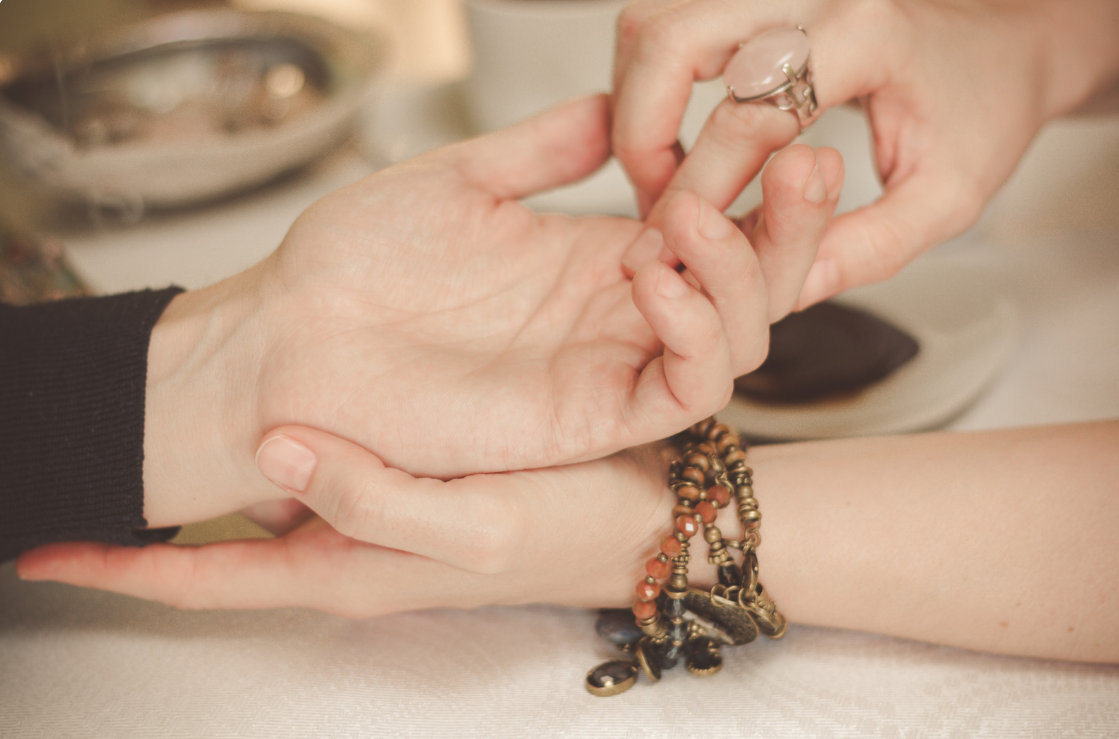
Palm reading, also called palmistry or chiromancy, is a divination tradition that assigns symbolic meanings to hand shape, fingers, mounts, and palm lines. It can be used for entertainment, storytelling, or self-reflection. It has not been scientifically established as a method for measuring personality, diagnosing disease, predicting lifespan, or revealing destiny.
The safest way to explore palmistry is to treat its meanings as traditional interpretations—not facts written into the hand. A reading may inspire a useful question, but important decisions still require evidence, consent, and appropriate professional advice.
How to look at a palm
Use comfortable light and let the hand rest naturally. Notice features before assigning meaning: line location, depth, breaks, skin texture, calluses, scars, flexibility, and differences between hands. Many features can change with age, work, injury, skin condition, movement, and how the hand is positioned.
Traditional readers sometimes compare the dominant and nondominant hands, but there is no validated rule that one reveals the present and the other reveals destiny. If you compare them, use the contrast as a storytelling device rather than a prediction.
The major palm lines in traditional palmistry
Heart line
This upper horizontal line is traditionally associated with emotion and relationships. A curved or straight line does not objectively show whether someone is loving, guarded, faithful, or able to recover from heartbreak.
Head line
The line crossing the middle of the palm is often linked with thought and communication. Its length or curve does not measure intelligence, creativity, concentration, or mental health.
Life line
The arc around the base of the thumb is traditionally connected with vitality and life changes. It does not predict lifespan, illness, or the quality of a person’s life. A short, faint, or broken line is not a warning of death or disease.
Fate or stability line
A vertical line toward the middle finger is sometimes interpreted as career, direction, or external influence. Not everyone has a prominent line, and its appearance cannot prove career success, failure, or a predetermined path.
Hand shapes, mounts, and elements
Some systems group hands into earth, air, fire, and water types using palm and finger proportions. These labels are symbolic categories. They do not establish that a person is practical, intellectual, restless, or sensitive.
Raised areas of the palm, called mounts, are also given planetary names in some traditions. Treat associations with confidence, love, imagination, or communication as part of the reading system, not as psychological assessment.
Fingerprints and rare markings
Loops, arches, and whorls are real fingerprint patterns used for identification, but palmistry meanings such as love, wisdom, luck, or life purpose are not scientifically validated. Likewise, crosses, stars, triangles, “intuition lines,” bracelets, and Apollo lines do not guarantee special powers, money, success, or good fortune.
A reflective palm-reading exercise
1. Choose one traditional symbol
Select a line or hand-shape interpretation from a palmistry system. State it as tradition: “Some readers associate this feature with communication.”
2. Turn it into an open question
Ask “When do I communicate clearly?” rather than “My hand proves I am a gifted communicator.” Open questions invite reflection without locking you into a label.
3. Look for evidence and exceptions
List recent examples that support and contradict the idea. This reduces the tendency to remember only matches.
4. Choose a small action
If the theme is communication, you might clarify an expectation or listen more carefully. If it is career, gather information or update a plan. Keep the action reversible and based in the present.
5. Avoid retrofitting
Record the interpretation before an outcome. Do not change vague wording afterward to make any event appear predicted.
Palm reading and health
Do not use finger length, line depth, color, or hand shape to estimate heart-disease risk, diagnose illness, or select treatment. Palmistry is not a medical examination. New pain, weakness, numbness, swelling, color change, a wound, or another concerning hand symptom deserves evaluation by a qualified healthcare professional.
A reader should never frighten someone with predictions of illness or death, sell a cure, or advise stopping medication. Health decisions require clinicians and appropriate testing.
Palm reading and psychics
A palm reader may rely on visual features, intuition, or both. Neither approach can verify another person’s private thoughts or future. Ask how the reading works, what it costs, and whether the practitioner makes health, legal, financial, or relationship claims.
Before paying for a session, review what a psychic reading can and cannot offer. Treat statements as prompts for reflection and never as sole evidence for a consequential decision.
Reading your own palm
Self-reading can be a creative journaling activity. Take a photograph if you want to compare observations later, but remember that lighting, camera angle, dryness, pressure, and hand position can change how lines appear. If intuition is part of the exercise, this grounded meditation practice can help separate observation from interpretation.
Frequently asked questions
Can palm lines predict how long I will live?
No. The life line does not predict lifespan, death, disease, or the quality of a person’s life.
Can palmistry diagnose health problems?
No. Palm reading is not medical testing. Seek qualified healthcare for symptoms, diagnosis, risk assessment, and treatment.
Which hand should I read?
Traditions differ. There is no validated rule that one hand shows destiny and the other shows the present, so either can be used for symbolic reflection.
Can palm reading still be useful?
It may be useful as entertainment, cultural tradition, conversation, or a source of reflective questions, provided its claims are not treated as verified facts.