
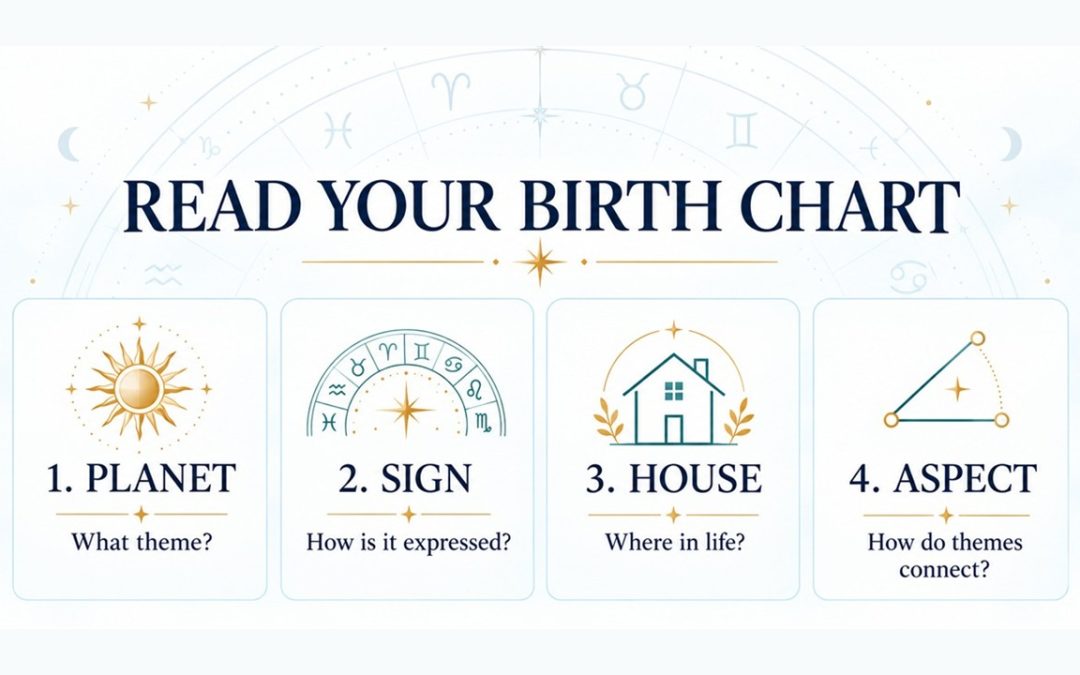
A birth chart brings several astrological symbols into one map. Your Sun sign is one part; the Moon, rising sign, planets, houses and aspects add other ways to explore identity, feelings and life themes. Learning the layers makes a chart easier to read without treating one placement as your whole story.
Use the symbols as a language for reflection. A chart can inspire a question about your habits or hopes, while your decisions, circumstances and lived experience remain part of the answer.
Start with accurate birth information
A natal chart is calculated for a birth date, time and place. Note whether the time comes from a record or is approximate. Check the town and time zone rather than entering your current home. Birth records vary in detail and are not always available.
The Ascendant and houses are especially sensitive to time and place. The Moon may change sign during a date, while the Sun changes sign near a sign boundary; not every planet changes sign within a few hours. If the time is unknown, mark time-dependent placements as uncertain instead of inventing a noon Ascendant.
Signs are not the same as constellations
In the tropical zodiac commonly used in Western astrology, the signs are twelve equal 30-degree sectors beginning at the March equinox. Astronomical constellations are star patterns with different boundaries. NASA’s explanation of the zodiac describes this distinction. Sidereal systems use a different reference; record which system your chart uses before comparing results.
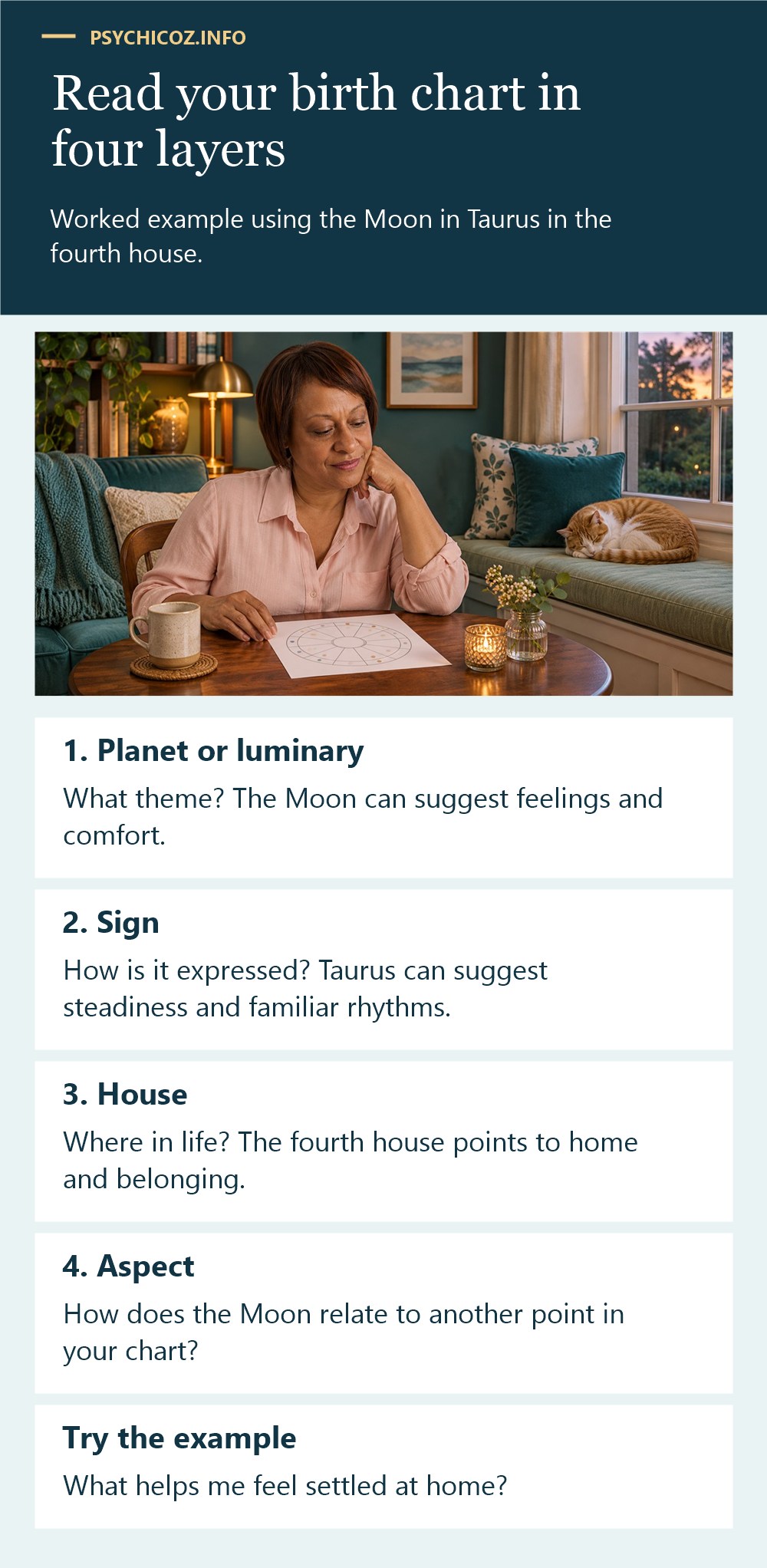
Read four layers together
1. Planet: what theme?
The planet or luminary supplies the topic: the Moon often represents emotional patterns, for example.
2. Sign: how?
The sign adds a symbolic style. A Taurus Moon might invite questions about steadiness, familiarity and comfort.
3. House: where?
The house connects the placement with an area of life. A Moon in the fourth may bring home and belonging into the reflection.
4. Aspect: what relationship?
Angles between placements add another layer. They do not turn a single interpretation into a guaranteed event.
Your Sun, Moon and rising sign
The Sun: direction and expression
Modern interpretations often use the Sun to explore identity, vitality and what feels purposeful. Ask when you feel most engaged and whether the description fits actual examples. You do not have to perform a stereotype of your sign.
The Moon: feelings and familiarity
The Moon is often read through emotional habits, comfort and responses to change. Ask what helps you settle and how you communicate a need. It is an astrological symbol, not a psychological diagnosis or a measurement of your “true” self.
The Ascendant: approach and chart orientation
The Ascendant is the point of the zodiac rising on the eastern horizon at that time and place. It helps orient the houses, though house systems divide the chart differently. It can symbolize how you approach a situation; calling it a mask need not imply you are being false.
Turn a chart theme into a wellbeing prompt
When you notice a theme like rest, belonging or confidence in your chart, ask where it already shows up in an ordinary day. If a Moon placement makes you think about belonging, you might identify one person you feel comfortable reaching out to this week. Your own experience can help you choose the next step.
Chart placements offer a language for reflection. For concerns about mood or anxiety that interfere with daily life, the National Institute of Mental Health explains when to seek support.
Planet themes at a glance
- Mercury: thinking, language and communication.
- Venus: attraction, pleasure and values.
- Mars: initiative, desire and how effort is expressed.
- Jupiter: growth, meaning and exploration.
- Saturn: limits, responsibility and structure.
- Uranus: disruption, freedom and experimentation.
- Neptune: imagination, ideals and uncertainty.
- Pluto: power, intensity and transformation.
Traditional and modern schools do not use every body in the same way. Start with a few placements and learn one approach consistently. More symbols do not automatically produce a more accurate description.
Four elements, many ways to express them
Fire: Aries, Leo, Sagittarius
Explore initiative and enthusiasm. Where does enthusiasm help you begin, and where would a pause help?
Earth: Taurus, Virgo, Capricorn
Explore practicality and continuity. What makes an idea workable in your actual routine?
Air: Gemini, Libra, Aquarius
Explore thought and exchange. Which conversation would help you understand another view?
Water: Cancer, Scorpio, Pisces
Explore feeling and imagination. How can you name an emotion without assuming what someone else feels?
An element count depends on which placements and weighting a method includes. A low count does not mean you lack a human quality. If you use elemental symbolism in a personal ritual, choose a comfortable practice rather than assuming a deficiency needs fixing. Our guide to Earth symbolism offers a closer look at one element.
The twelve houses as life topics
- First: self-presentation and approach.
- Second: resources, possessions and values.
- Third: everyday learning, siblings and communication.
- Fourth: home, roots and private life.
- Fifth: creativity, pleasure and romance.
- Sixth: routines, work and service.
- Seventh: one-to-one partnerships and agreements.
- Eighth: shared resources, intimacy and change.
- Ninth: belief, study and wider horizons.
- Tenth: public responsibilities and vocation.
- Eleventh: friendships, groups and collective aims.
- Twelfth: retreat, less-visible experiences and inner life.
A house theme is not a finding about your health, finances or future. Whole-sign, equal-house and quadrant systems can place a planet in different houses. Keep the chosen system visible and avoid mixing results as though they were one calculation.
Worked examples: turn a placement into a question
These are invented placement examples, not calculated charts for real people. They show the reading process without pretending that every combination defines a personality.
Example 1: Mercury in Gemini in the third house
Combine: communication + curiosity + everyday learning.
Ask: “When does gathering another viewpoint help me communicate, and when do I need to finish one thought?”
Try: summarize one idea before opening another tab.
Example 2: Moon in Taurus in the fourth house
Combine: emotional habits + steadiness + home.
Ask: “Which familiar routine helps me feel settled, and can I adapt it when life changes?”
Try: choose one comforting evening routine that fits your current circumstances.
Example 3: Venus at 15° Taurus, Mars at 15° Cancer
Taurus begins at 30° and Cancer at 90°, so the positions are 45° and 105°. Their shorter separation is 60°: an exact sextile.
An astrologer might explore how values and initiative cooperate. The geometry does not verify compatibility, attraction or consent.
Example 4: A time-dependent house
If the birth time is uncertain, write “Moon sign to confirm; house unknown” where necessary. Do not borrow a convenient rising sign from an approximate chart.
A useful question can remain open until the underlying information is clearer.
Decans and birthdays near a sign boundary
A decan is a 10-degree third of a sign: 0° up to 10°, 10° up to 20°, or 20° up to 30°. Rulership schemes vary. Read the exact sign degree before using a decan description; calendar-date shortcuts are approximate.
Being born near a sign change does not place the Sun in two signs at once within one zodiac calculation. You may relate to both descriptions, but confirm the Sun’s position for the time and system. Other placements can also explain why a simple Sun-sign profile feels incomplete.
Free birth-chart reading sheet
Copy this template for one placement at a time. Keep birth details private when sharing an example.
- Input certainty: date, time source and location; what remains unknown?
- Calculation choices: tropical or sidereal; which house system?
- Placement: planet, sign, degree and house if reliable.
- Theme: combine the four layers in one sentence.
- Real example: when does it fit, and when does it not?
- Next choice: one useful question or small action.
Sample: “Mercury / Gemini / third house → curious communication → I enjoy asking questions, but sometimes interrupt → let the other person finish before asking the next one.”
How two people with the same Sun sign might use their charts
Two Virgos may both connect with the sign’s attention to detail. One might use it to explore why they enjoy organizing shared plans. The other might ask why they keep refining something that is ready to share.
Try it on your chart. Look at your Sun sign, then pick one Moon or rising-sign theme. Which theme fits the particular situation you’re thinking about?
Build understanding one layer at a time
Learn your main placements, then compare a few aspects and house themes. Later you can explore transits and retrogrades without interpreting every symbol at once. A reading can provide another perspective; our guide to what a psychic reading can offer can help you decide what questions to bring.
Leave room for a description that does not fit. You can appreciate astrology’s spiritual language without allowing a chart to decide a medical concern, a relationship boundary or another person’s private feelings.
Frequently asked questions
1. What is a birth chart?
It is an astrological map calculated for a birth date, time and place. Its symbols can be used to reflect on life themes.
2. Is my Sun sign the whole chart?
No. The Moon, Ascendant, planets, houses and aspects add other layers.
3. Why does the birth time matter?
It is especially important for the Ascendant and houses. It can also affect a fast-moving placement or a sign change.
4. What if I do not know my birth time?
Mark it as unknown. Avoid treating an approximate or noon chart as a reliable source of your Ascendant and houses.
5. Are signs the same as constellations?
No. Tropical signs are equal 30-degree sectors; astronomical constellations have different boundaries.
6. Why do two websites give different results?
Check birth inputs, time-zone handling, zodiac system and house system before comparing interpretations.
7. What does the Moon symbolize?
Many modern interpretations connect it with emotional habits, familiarity and comfort. It does not diagnose your mental health.
8. What is the rising sign?
It is the zodiac sign at the Ascendant, the point rising on the eastern horizon for the birth time and place.
9. What are houses?
They are chart divisions associated with life topics. Different systems divide them differently.
10. What is an aspect?
It is an angular relationship between placements. Its symbolic interpretation depends on the astrological approach.
11. What is a decan?
It is a 10-degree third of a sign. Decan rulership traditions vary.
12. Can I have two Sun signs because I was born on a cusp?
Within one zodiac calculation, the Sun has one position. Use the actual birth information to check a boundary date.
13. Does a missing element mean I lack a quality?
No. An element count depends on a method and cannot establish that you lack a human ability or trait.
14. Are the worked examples real people’s charts?
No. They are invented placement examples that demonstrate how to combine symbols and form questions.
15. How do I start without getting overwhelmed?
Read one placement through planet, sign and house, then consider a relevant aspect. Record real examples and leave uncertainty visible.